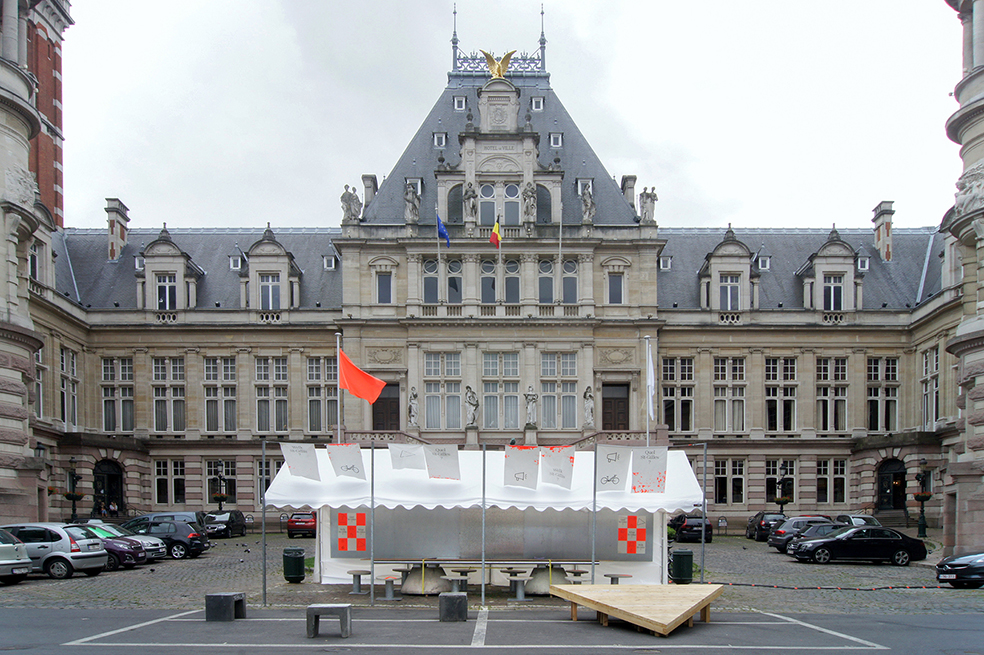
Latitude Platform gathers researchers and practitioners engaged in context-based urban research and design. The platform aims to understand space in all its dimensions, focusing on the everyday as well as emergencies and crises in both consolidated and marginal contexts. From this perspective, design is interpreted as an open process aimed at improving the socio-ecological conditions of the considered territories. Interdisciplinary and plural perspectives are fundamental to Latitude Platform. Building on the tools and practices of urban studies and landscape architecture, Latitude’s projects often involve the participation of anthropologists, sociologists, ecologists, photographers and artists, among others. Based in Brussels, Venice and Rome, the platform collaborates with universities, non-governmental organisations, local associations and committees, as well as public institutions.
members
Andrea Aragone, Andrea Bortolotti, Federico Broggini, Davide Cauciello, Marta De Marchi, Alessandra Marcon, Octavio Piñeiro Aramburu, Marco Ranzato, Riccardo Ruggeri, Fabio Vanin.
past members
Olivia Casagrande, Marta Finotello, Roberto Genna, Martina Gentili, Federico Gobbato Liva, Sadhia Khan, Griet Lambrechts, Tullia Lombardo, Aryani Sari Rahmanti, Michiel Vanbalen, Cati Vilquin.
collaborators
Matteo Cucciniello, Federico Marchese, Bruno Dias Ventura, Bieke Holemans, Julien Rialland, Athanassia Sakellariou.
past collaborators
Smaranda Alexandresku, Lili Bartos, Lina Bentaleb, Valentina Bonifacio, Pauline Cabrit, Elena Calafati, Beniamino Casagrande, Viola Castellano, Simone Conz, Romina Cornejo Escudero, Caterina Dubini, Bianca Fanta, Mara Fathy, Chiara Ferronato, Eleonora Giannetti, Ombeline Hinfray, Alma Kelber, Roberta Marcolongo, Andrea Masciantonio, Maria Vittoria Massi, Talita Medina, Tommaso Mola Meregalli, Kewalin Num-In, Anna Penso, Stefano Reolon, Manoe Rouhe, Chloé Rouzerol, Marta Sieminska, Thomas Stefani, Joséphine Steyaert, Paolo Vanin, Alizé Van Reeth, Luca Ventimiglia, Adrian Vickery Hill, Benoît Zachelin, Costanza Zeni, Sabeha Zerouali.
address
Avenue des Arts 24,
1000 Bruxelles, Belgium
email
info@latitude-platform.eu
website by Julien Dutertre and Alexis Jacob
- upper
- project name
- period
- location
- type
- initiative/fund
- network
-
IE (L) Ilot d'Eau 2018-2025 Forest, Brussels-Capital Region, Belgium publication Innoviris Co-Create Bruno Dias Ventura, Alexis Jacob, Nicolas Storck, Ivone Martínez Feria


The story of Îlot d’Eau is that of the collaborative design process undertaken between 2015 and 2020 with residents, professionals, researchers, students, and representatives of local public institutions as part of two action research projects: the socio-economic Sustainable Neighbourhood Contract project, Des Nouveaux Chemins Solidaires pour le Quartier de l’Abbaye; and the Co-Create project, Brusseau – Brussel sensible à l’eau. All activities were geared towards exploring the possibility of expanding material relationships with water within the dense urban landscape of Forest, a municipality southeast of Brussels (Belgium). This process is illustrated through a rich iconographic collection consisting of photographs, maps, collages of collaborative moments and drawings created collectively and those redrawn in the office. A concise text explains the main steps. This logbook is complemented by a leaflet with different paper and size features, which is inserted in the book and guides the reader through the activities section. Each page of the leaflet has a heading with an activity title and numbers that recall the sequence of activities and workshops, as well as a central ideogram that indicates the activity type. The logbook concludes with contributions from Juan López Cano of Orizzontale and Cristina Cerulli of Polpo, who reflect on the opportunities and pitfalls encountered during the design process.
-
SPL San Paolo 2025 Martina Franca, Puglia, Italy competition Città di Martina Franca Claudio Carrieri, Vittorio Gemignani
-
MNR Mayen Reverier 2023-2025 Charvensod, Valle d'Aosta, Italy architecture private Tommaso Mola Meregalli


Situated on the edges of Reverier Dessous at an elevation of 1,000 metres above sea level on the north-western slope of Mount Emilius in the Aosta Valley in Italy, the mayen is a type of farm building endemic to the Western Alps. It is usually found halfway between the valley and the mountain pastures. Towards the end of the last century, the mayen underwent expansion work that substantially modified the initial structure. For this reason, in 2022, the municipality agreed to the owners' request to demolish the building and rebuild it. Latitude Platform and Tommaso Mola Meregalli then proposed constructing a house on the site that would essentially replicate the previous building's volumetric development. Retaining walls regulate the relationship with the context, mediating the connection with the slope and supporting access paths and changes in elevation. Many of the demolition materials from the previous building have been reused in the foundations of the small car space to the north, the building itself, the internal and external flooring, and the new extensions of the retaining walls and their finishes. The east-facing roof, which overlooks the pastures, is made of stone tiles and extends southwards to provide shade during the summer months, reinterpreting a local bioclimatic solution. The west side comprises photovoltaic panels that power a heat pump capable of producing the energy needed to meet the house's requirements. Two stormwater detention and storage tanks, located at the eastern and western ends of the northern and southern retaining walls respectively, collect rainwater for use in watering the small family vegetable garden.
-
BBS Brussels-Based 2025 Brussels-Capital Region, Belgium exhibition Marcello Carpino, Côme Rolin, Olivier Thomas, Leander Venlet, Bouwmeester Maitre Architecte, D'Ietern, A+ /
Content Texte
-
SPV Primes Vertes 2024-ongoing City of Brussels, Brussels-Capital Region, Belgium feasibility study City of Brussels Athénée Royal BXL2, Collège de la Fraternité, Ecole Sainte Ursule de Laeken, European School Brussels IV, Sint-Ursula basisschool
Content Texte
-
CAD Cadol & Swartenbroeks 2024 Koekelberg, Brussels-Capital Region, Belgium competition BMA Boumeester Maître Architecte, Koekelberg Municipality epoc, Studio Gallice
Content Texte
-
EPZ ZEMU Quai des Usines 2024 City of Brussels, Brussels-Capital Region, Belgium feasibility study perspective.brussels Kaderstudio, Studio Tuin en Wereld


-
FV Fuori Volume 2024 Sabato watershed, Campania, Italy exhibition Ordine degli Architetti, Pianificatori, Paesaggisti e Conservatori della Provincia di Avellino Tommaso Mola Meregalli


The unique morphological and orographic features of the Avellino basin are crucial in regulating its microclimate, which is temperate but at times continental. The verticality of the Apennine orography blocks the rain, giving rise to the bodies of water present in the valley. Thus, through the interaction between rainfall and its infiltration into the soil, the many springs form the hydrographic network from which the Sabato river originates. The layering of urbanization in the Sabato river valley shapes its nature: canalizations, waterfalls, concrete banks, and barriers have altered it over time, turning it into a completely anthropic feature. In this context, a reading is proposed that contrasts the presence and potential of water, which exists in many forms within the Sabato river basin, with the difficulty of accessing these hydraulic forms, which could serve as potential points for both human and non-human relations.
-
AMO AMO Forest 2024 Forest, Brussels-Capital Region, Belgium feasibility study Municipality of Forest Aries


-
PM Park Mobil 2024-ongoing Ganshoren, Brussels-Capital Region, Belgium co-design, installation, landscape architecture Sustainable Neighbourhood Contract Villas de Ganshoren Bûûmplanters, ERU Urbanisme
Content Texte
-
DEW Ilot De Wand 2024-ongoing City of Brussels, Brussels-Capital Region, Belgium co-design, installation, landscape architecture Foyer Laekenois Asbl Cité Modèle, Collectif Dallas, Foyer Laekenois


Ilot de Wand is a collaborative landscape and urban design project undertaken in the courtyard of a social housing complex in the north of the Brussels Capital Region. The aim is to improve on-site circulation of rainwater by incorporating new infiltration surfaces and to enhance the diversity of collective outdoor spaces by designing bespoke furniture by the reuse of materials mainly found onsite. By hacking into the existing gutters, the water running off the roof is redirected away from the sewer system and towards the basketball court flooring, which has been desealed to make it more permeable. The removed asphalt blocks are being reused to make new community facilities, including a small circular cycle path, seating areas and sports equipment. Both areas have been planted with perennial species that have been selected to minimise maintenance requirements while improving the capacity for infiltration, evaporation and transpiration.
-
KUM Masterplan Kumtich 2024 Kumtich, Flanders, Belgium competition Vlaams Bouwmeester Kaderstudio, Studio Tuin en Wereld
Content Texte
-
TMW Tailor-Made Water 2024 Rotterdam, The Netherlands installation 11th IABR International Architecture Biennale of Rotterdam Collectif Dallas, De Spoortuin, Hefpark


Tailor Made Water is one of the 26 Botanical Monuments of the 11th edition of the International Architecture Biennale Rotterdam (IABR) 2024 – Nature of Hope. The Botanical Monuments are green sites in Rotterdam that embody the biennale’s ambition to reshape architecture’s relationship with nature, focusing on ecology and coexistence. Spread across the city, these initiatives create a living network of public gardens and green practices that encourage biodiversity, civic awareness, and long-term collaboration with nature. Tailor Made Water explores rainwater harvesting through two site-specific installations in urban agricultural parks: Hefpark and Spoortuin. Hefpark is a resident-managed garden with vegetable plots, a bicycle pumptrack, and community spaces. Here, Latitude and dallas integrate water recovery techniques into a pétanque court, outdoor furniture, planting areas, and a covered gathering space. Spoortuin, a geometric above-ground garden defined by concrete clinkers, hosts a central rainwater tank. Its one-metre square cone doubles as a striking rain gauge, highlighting the garden’s water cycle. Through these interventions, Tailor Made Water turns small-scale gardens into laboratories for urban resilience and community-based water management.
-
FLU Flux Urbains 2023-ongoing Iijssel watershed, Inn watershed, Lea watershed, Meurthe watershed, Neckar watershed, Piave watershed, Senne watershed, Ticino watershed; IUAV, Venice, Veneto, Italy (workshop, exhibition) research, workshop, installation Università IUAV di Venezia (workshop) urbanes.land, Raumlabor, Chiara Cavalieri, Andrea Conte, Korbinian Enzinger, Marie-Lise Hofstetter, Andreas Krüger, Elena Longhin, Christian Nolf, Carlotta Olivari, Claudia Pasquero, Marco Poletto, Jose Alfredo Ramirez, Michael Schmölz


flux.urbains incites a River Urbanism Movement across the continent. Eight existing teams of research and action that have started to care about individual rivers, join forces, ideas, and the shared ambition to re-position the secondary rivers: as potentials for learning and understanding today’s Europe, its recent and ongoing transformations, collective identity, and a liveable future. The network acted for the first time in Venice on May 20th, 2023, on the occasion of the Architecture Biennale 2023. Rivers’ representatives—be they inhabitants, associations, experts, institutions—have come together to set an agenda for secondary rivers of hybrid condition. It started with a close look on everyday conditions and practices, emerging issues, and projects, drawing stories from who and what is already there.
-
BIR Hotel Biri Padova 2023 Padova, Veneto, Italy feasibility study Hotel Biri Padova UP Studio
Content Texte
-
IDW Grijze Materie 2023 Antwerp, Flanders, Belgium workshop, installation International Design Week, University of Antwerp Collectif Dallas, Lambrechts Hout, Stadshout, Studio Tuin en Wereld


Grijze Materie is a one-week workshop organized as part of the University of Antwerp’s International Design Week programme, centered on reuse as a response to rising construction costs. The workshop activates networks and interactions around construction materials, proposing alternative approaches to public space design in times of economic constraint. Much like a storm leaves behind a landscape of debris, the surge in construction prices has resulted in an accumulation of surplus materials—residues that may offer new possibilities for rethinking the economy of public space projects. Focusing on the context of Antwerp—a city closely connected to its seaport and characterized by large daily flows of materials—the workshop explores how surplus construction resources can be creatively reappropriated to tackle contemporary urban and ecological challenges. Through cartographic mapping, videographic documentation, and hands-on construction sessions, participants examine the potential of these overlooked materials to inform new practices in public space design and resource management.
-
IEE Ilot d'Eau Ensemble 2021-2023 Molenbeek watershed, Brussels-Capital Region, Belgium research, installation, landscape architecture Innoviris Experimental Platform Arkipel, Asbl Cité Modèle, Brussels Environment, Collectif Dallas, Commune de Berchem-Sainte-Agathe, Commune de Ganshoren, Commune de Jette, Ecotechnic, Etats Généraux de l’Eau à Bruxelles (EGEB), Faculté d'Architecture La Cambre Horta (Université Libre de Bruxelles), Foyer Laekenois, HYDR (Vrije Universiteit Brussel), Picol asbl, Quartier Durable Marelle, Ville de Bruxelles, Vivaqua


Ilot d’Eau Ensemble is an experimental design and research project developing low-tech, decentralized devices for integrated rainwater management in individual and collective residential gardens in the Brussels-Capital Region. Through participatory actions, the project explores new design practices for urban water management and proposes wetness as a guiding paradigm, placing rainwater at the center of spatial, ecological, and social relationships. Rainwater is understood not only as a technical matter, but as a living actor linking roofs, gardens, soils, plants, animals, and human practices. Processes such as infiltration, evaporation, evapotranspiration, runoff, and temporary flooding are treated as elements of a distributed, living wet infrastructure. Residential gardens are the primary field of investigation. Their widespread presence in Brussels gives them strong potential for rethinking rainwater management at a local scale, while their cultural and ecological value supports diverse human and other-than-human practices. A key outcome of the project is a construction manual with DIY instructions for five rainwater devices adapted to gardens: ditches, swales, infiltration basins, ponds, and storage tanks. These devices can be combined into flexible assemblages and were tested in six gardens through a three-phase participatory process combining collective design workshops and on-site construction. Each garden becomes a micro-landscape that buffers stormwater, supports biodiversity, and fosters new forms of coexistence.
-
MDS Museo della Scienza 2022-2023 Rome, Lazio, Italy competition Municipality of Roma Capitale GANKO, Supervoid


The Forum of Science is conceived as a new cultural hub for Rome: an architecture that link memory and science, archive and laboratory, becoming a place of encounter and exchange around scientific culture and art. Within this framework, the design of open spaces plays a key role, not simply connecting the museum to the city but reinforcing its ecological and social dimension. Via Guido Reni today remains largely mineral and impermeable, disrupting natural cycles. The project addresses this condition by introducing ecological devices able to regulate the microclimate, manage stormwater, and mitigate pollution and heat. Three main interventions articulate the architectural program. The greenhouse is both botanical garden and climatic laboratory, a flexible space for vegetation, leisure, and temporary events. The garden is an accessible urban void, absorbing rainwater and shaping an ever-changing topography of greenery and seasonal colors. Finally, the terrace becomes a climatic “room,” shaded and refreshed in summer, open to sunlight in winter, framing panoramic views of Rome. Together, these open spaces define a series of performative landscapes—not static backdrops, but adaptive ecologies where environmental functions and social uses overlap, offering the city resilient and ever-evolving shelters.
-
PML Potager Modèle 2023-ongoing City of Brussels, Brussels-Capital Region, Belgium co-design, installation, landscape architecture Climate Action, City of Brussels Asbl Cité Modèle, Collectif Dallas, Foyer Laekenois, Molleke, Skyfarms, Les Jeunes Jardiniers


Potager Modèle is a community garden that promotes sustainable food systems and biodiversity through collective action. From January 2023 to June 2024, Latitude Platform, in collaboration with Foyer Laekenois, Collectif Dallas, Skyfarms, and Molleke, coordinated various activities in Laeken’s Cité Modèle to renovate the existing garden with the help of local residents and nearby organizations. The garden features 20 individual cultivation plots, a communal composting station, a greenhouse, three rainwater tanks, three ponds, and a shared plot for gardening workshops. The project divert existing gutters to collect rainwater for irrigation, helping to reduce the flow of clean water into the sewer system. By reusing mineral and organic materials—such as klinkers to delimit the plots and earth to create new topography—the project minimizes reliance on new resources, fostering a local and circular approach to landscape design.
-
RN Roma Novissima 2023 Rome, Lazio, Italy exhibition Azienda Speciale PalaExpo Warehouse Architecture, Marco Garofalo


Dedicated to the divine goat Amantea, whose broken horn, according to myth, is a source of nourishment, the bridge is a structure that stretches across to harness the Tiber and to ceaselessly draw out its abundance. Like the cidolo that sifts the timber carried by the river, the Ponte dell’Amantea holds back what the current brings even as the waters continue to flow. The abundance, little by little, accumulates into deposits of fish, mussels, snakes, rats, coypus, corpses, dust, sands, pozzolana, tuff, travertine, fruit, flowers, leaves, brushwood, trunks, trees, jars, cans, bottles, cigarette butts, sacks, cardboard, bicycles, bumpers, tires, rims, windshields, doors, chairs, wardrobes, bricks, window frames, panels, washing machines, refrigerators, toasters, irons, pistols, rifles, cocaine, shoes, underwear, trousers, jackets, t-shirts, and so on. Crushed under the weight of abundance, the scaffolding stretches on without rest, seeking supports and binding still-unbridled river flows.
-
CRU8 CRU 8 Stephenson – Reine 2023-ongoing City of Brussels, Schaerbeek, Brussels-Capital Region, Belgium urbanism Urban Renovation Contract, perspective.brussels Kaderstudio, Studio Tuin en Wereld, ABO
Content Texte
-
ULA Upper Latina 2022-2023 Latina, Lazio, Italy landscape architecture Municipality of Latina ADML Architetti, Orizzontale, Claudio Cappella, Silvio Cristiano


Building on the specific characteristics of the site and the guidelines of the UPPER project, this proposal envisions an innovative intervention of renaturalization and wetland restoration. It aims to hybridize the ecological vocation of a wetland with productive uses, while ensuring full accessibility, expanding the availability of spaces for local communities, and accommodating a wide range of activities. The new, expansive wetland is conceived as an open field—a kind of commons—capable of hosting diverse uses. The site’s topography allows certain areas to remain dry, and the periodic cutting of reeds will make specific zones more accessible, creating variable and temporary spatial configurations that may include or exclude the central platform. Windbreak and noise-buffer vegetation on the eastern side will serve as large, green backdrops.
-
EFH Héliport-Anvers 2023-ongoing City of Brussels, Brussels-Capital Region, Belgium feasibility study Foyer Laekenois Sustainable Neighbourhood ContractHéliport-Anvers, Energ-Ir, Kaderstudio, Andrea Migotto, Ney & Partners, Studio Tuin en Wereld


-
MVV Maelbeek Vallée Verte 2023 Ixelles, Brussels-Capital Region, Belgium installation Brussels Mobility Collectif Dallas, Etats Généraux de l’Eau à Bruxelles, Gray-Couronne Community garden, Ixelles Municipality, Loop Studio


Maelbeek Vallée Verte is an installation created as part of the "Brussels on Holidays" projects (Brussels Mobility grant), and invites citizens to reflect on the future of car mobility and the role that water and vegetation can play in reducing the impact of urban flooding. Gray Street, which partially follows the former marshlands of the Maelbeek catchment area, is particularly vulnerable to water-related issues and sewer overflows, which regularly flood homes with both clear and wastewater.
-
JAC Jacquet 2023 Koekelberg, Brussels-Capital Region, Belgium competition BMA Boumeester Maître Architecte, Koekelberg Municipality ARA, L'Architecture qui Dégenre, vvv architecture urbanisme


-
CLV Cité Liverpool 2022-ongoing Molenbeek-Saint-Jean, Brussels-Capital Region, Belgium landscape architecture Sustainable Neighbourhood Contract Petite Senne, Logement Molenbeekois Atelier 4/5, Energ-Ir, Kaderstudio, Ney & Partner, Olivier Graeven, Securisan, Stéphane Haffmans
Content Texte
-
SJF Square Jacques Franck 2022 Saint-Gilles, Brussels-Capital Region, Belgium competition BMA Boumeester Maître Architecte, Saint-Gilles Municipality Arcadis, Basil Descheemaeker, Gilles Pieters Landschap, Urban Species


-
FUT Campolongo Maggiore 2022 Campolongo Maggiore, Veneto, Italy architecture, landscape architecture Ministero dell'Istruzione e del Merito, Municipality of Campolongo Maggiore Aurelio Brunello, David Canale, Roberto Lovat, Alessandro Iannello, Massimo Negrisolo, W.E.I.’N VENICE
Content Texte
-
WSB Watersportbaan Gent 2022-ongoing Ghent, Flanders, Belgium urbanism Ghent Municipality Els Vervloesem, Fallow
Content Texte
-
SAX Site Axima 2020-2022 Forest, Brussels-Capital Region, Belgium research Forest Municipality, BMA Bouwmeester Maître Architecte Communa
Content Texte
-
FUT Oliveto Citra 2022-ongoing Oliveto Citra, Campania, Italy architecture, landscape architecture Ministero dell'Istruzione e del Merito, Municipality of Oliveto Citra Aurelio Brunello, David Canale, Roberto Lovat, Alessandro Iannello, Massimo Negrisolo, W.E.I.’N VENICE


The new school complex in Oliveto Citra is a multifaceted, adaptable, and permeable facility that offers students and residents a variety of opportunities for learning, social interaction, sports, and engagement with the local climate and plant life. Architectural elements—such as openings, materials, and technical systems—are all designed to reveal the building’s bioclimatic functioning. The project interprets the school as an interface with the climate of Oliveto Citra and the upper Sele Valley: an architectural device through which to experience care for the environment, understood as a common good. The flexibility of the school’s spaces supports a teaching approach that fosters active learning, in line with the principles of the “Scuola Senza Zaino” (School Without a Backpack) movement, of which the J. Sannazzaro Institute is a member. Accordingly, the design choices promote physical activity and both direct and guided experiences, helping students develop skills in autonomy, safety, and citizenship.
-
PCV Petit Chemin Vert 2022 Neder-Over-Hembeek, Brussels-Capital Region, Belgium competition BMA Boumeester Maître Architecte, City of Brussels ABO, Studio Tuin en Wereld
Content Texte
-
VPF My Street is a Garden 2022-ongoing Forest, Brussels-Capital Region, Belgium urbanism Sustainable Neighbourhood Contract Wiels-sur-Senne, Forest Municipality Collectif Ipé, Les Saprophytes, Maison des Jeunes de Forest, Miro, Une Maison en Plus, Verte Berthelot


My Street is a Garden is a project under the Wiels-sur-Senne Sustainable Neighborhood Contract, developed by Latitude Platform in collaboration with Collectif Ipé and Les Saprophytes. The initiative focuses on creating new green and permeable spaces in the Saint-Antoine and Primeurs neighbourhoods, Municipality of Forest. These efforts aim to manage rainwater runoff and mitigate flooding in an area that is particularly vulnerable to water-related issues and one of the most densely populated in the Brussels-Capital Region. Through a series of participatory activities, residents played a role in the project, selecting intervention sites, influencing design decisions such as plant choices and furnishings, and identifying two locations designated for shared management between the municipality and local inhabitants.
-
HCZP Health Campus Zuid Parking 2022 Hasselt, Flanders, Belgium urbanism POM Limburg Kaderstudio, Studio Tuin en Wereld


-
GWG Green With Grey | Groen Met Grijs 2018-2022 Flanders, Belgium research, workshop Department Omgeving, Vlaamse Overheid Aquafin, Architecture Workroom Brussels, Asiat Site, Cargovil vzw, David Giacomelli, Departement Omgeving, Katholische Universität Leuven, Loop Studio, Onkruid, Plant en Houtgoed, POM Vlaams-Brabant, Université Catholique de Louvain, Vilvoorde Municipality, VLAIO, VLM, VMM, 51N4E, 1010au


Flanders is one of the best-known productive regions of Europe. Concentrating the majority of the Belgian industry and workforce, the Region features a continuous and dense infrastructure throughout its landscape: slabs of asphalt and concrete, tiles, sheds, wide roads, unused vegetated remnants of space, and industrial platforms. These elements cover approximately 4.5% of the urbanisation of the region and 15% of its overall land take, becoming a major question when it comes to the soil impermeabilization and water management question. This work looks at industrial platforms as water towers spread right across the Flemish territory. Water towers that nowadays are inactive, thus repelling approximately millions of m3 of rainwater. What if this water tower are turned on instead? GreenWithGrey is one of the strategic projects of the “Proeftuinen Ontharding,” a programme aiming at tackling the very diffuse – and land consuming – urbanisation of Flanders through strategic desealing actions. Within this framework, GreenWithGrey explores possibilities for desealing Flemish industrial platforms to tackle questions such as providing more room for water and strengthening the regional water cycle. GreenWithGrey achieves the ongoing transition through a mix of doing and undoing, of actions and policies, of top down and bottom-up strategies.
-
CON CQD Conscience 2022 Evere, Brussels-Capital Region, Belgium competition BMA Boumeester Maître Architecte, Evere Municipality Karbon, brat, spec uloos


-
GWG (L) Green With Grey | Groen Met Grijs 2019-2022 Flanders, Belgium publication Department Omgeving, Vlaamse Overheid Architecture Workroom Brussels, David Giacomelli, Departement Omgeving, Katholische Universität Leuven, Alexis Jacob, Nicolas Storck, POM, RomaTre University, Université Catholique de Louvain


-
LDW Le Long du Wilderbeek 2022 Berchem-Sainte-Agathe, Brussels-Capital Region, Belgium installation Brussels Mobility Berchem-Sainte-Agathe Municipality, Collectif Dallas, Etats Généraux de l’Eau à Bruxelles, Loop Studio


As part of the Brussels On Holidays programme, Le Long du Wilderbeek is a temporary public space located in Berchem-Sainte-Agathe, Brussels-Capital Region. In the summer of 2022, existing klinkers collected from communal storage were repurposed to create a planter and a bench, and the reorganization of street flower pots helped slow down traffic. This initiative is part of the broader participatory process led by the BrusseauBis action-research project (Innoviris Experimental Platform), which promotes collaboration between public and private stakeholders in the Molenbeek catchment area. The project aims to develop an integrated approach to water management through co-design and co-construction workshops.
-
CWS Chinese Whispers 2019-2021 Ixelles, Brussels-Capital Region, Belgium installation private Federica Fantini
Content Texte
-
EDC Eau de Couture 2021 City of Brussels, Brussels-Capital Region, Belgium installation, action project / Collectif Dallas, Bruno Dias Ventura, Habitat & Rénovation, Loop Studio


Eau de Couture is a project realized in Jardin Akarova, a collective garden sitting in front of the social housing blocks of the Brigittines neighbourhood in the heart of Bruxelles. The project consists in the co-construction and renovation of a public space, together with inhabitants and local associations, revolving around a rainwater collection tank for irrigation and a vegetated buffer area for overflow water. Eau de Couture is part of the projects Initiatives Durables 2020, focused on urban agriculture and promoted by the municipality of Bruxelles Ville. The material re-use approach is one of the main design principles of the project team. In this sense the collaboration between the municipality and the design team has been constructive and dynamic: Bruxelles Ville made available the warehouse where all the materials concerning public spaces are stocked. The base of the rainwater tank and the overflow system is designed re-using the materials found in the warehouse. In Eau de Couture we aimed to design a prototypical device to collect water that, by an economy of means, helps to better define and enhance public spaces. We imagine that Eau de Couture can be adopted in different locations according to the specificities of each context.
-
VHB Ville Haute Ville Basse 2021 City of Brussels, Brussels-Capital Region, Belgium competition City of Brussels, BMA Bouwmeester Maître Architecte a practice
-
COU Couronne 20e Siècle 2021 City of Brussels, Brussels-Capital Region, Belgium competition perspective.brussels CalmE, Carbonifère
Content Texte
-
HCZ Health Campus Zuid 2021 Hasselt, Flanders, Belgium urbanism POM Limburg Kaderstudio, Studio Tuin en Wereld


Health Campus Zuid is one of the sub-campuses of the larger Diepenbeek campus, which is home to Hasselt University in Flanders, Belgium. Between 2016 and 2018, the province of Limburg (with AgenceTer as the designer) developed a master plan to transform Diepenbeek into an eco-campus for education, research and activities in the fields of healthcare. Health Campus South is a development project by Latitude Platform, Studio Tuin en Wereld and Kader Studio. It aims to regenerate the area by developing it more densely. The master plan for the entire eco-campus includes four buildings: one at the entrance to the car park, and three denser buildings to accommodate additional knowledge institutions, businesses, and healthcare organisations. The densification vision is based on maintaining the existing buildings, providing continuous shared spaces (third places), offering spaces with varying levels of climatic comfort depending on their function and proximity to shared spaces, incorporating a large constructed wetland for grey water recycling and expanding the wetland/riparian area along the course of the Miezerikbeek. Contrary to the general plan, the stream is expected to be relocated to a more central area of the sub-campus to become the driving agent of Health Campus South.
-
POW Public Organic Waste 2021 City of Brussels, Brussels-Capital Region, Belgium mapping City of Brussels, Département Centrale d'Achats Centre d’écologie urbaine, Environnement Eco-Circulaire, Groupe-One Ecores, Osmos
Content Texte
-
PDC Piazza dei Cinquecento 2021-ongoing Rome, Lazio, Italy urbanism Grandi Stazioni FS Artelia, IT’S, Net, OSA, TVK


Piazza dei Cinquecento stands out as an exception due to its vast spatial dimension, positioning it as a potential center of public life in the Rome of tomorrow. The design proposal for the square seeks to contribute to a broader vision for the city’s future by reintegrating this void into the public life of the city and reconnecting it to nearby landmarks such as Piazza della Repubblica, the Baths of Diocletian, the Servian Walls, and Palazzo Massimo. By rediscovering and reactivating the void, the project aims to clarify, define, and connect the interior of the station to the city through a space of exchange that is open and adaptable to multiple uses over time. The future of “Territorio Termini” lies in embracing plurality. As an intermodal hub operating at supranational, national, and local scales, Termini is both a point of passage and of rest for a highly diverse public. If the future of Termini is to be grounded in plurality as a value, it must also recognize and care for marginality, rather than neglect it. A fundamental condition for the future of a “Plural Termini” is a participatory approach, that will accompany the project’s development, construction phase, and the ongoing life of the future Piazza dei Cinquecento. A series of actions are designed to collectively envision and shape the future development. These will include interventions in public space through co-design and co-construction of key strategic areas such as spaces that will remain programmatically open to the evolving needs of both passersby and residents.
-
VEN Veneto 2100 - Living with Water 2020-2021 Veneto, Italy publication / Nadia Breda, Michiel Dehaene, Silvana Editoriale, Studio Iknoki, Sybrand Tjallingii, Jonmar van Vlijmen


-
GEJ Général Jacques 2021 Ixelles, Brussels-Capital Region, Belgium competition SLRB, BMA Bouwmeester Maître Architecte Atelier 4/5, KaderStudio
-
PAD PAD Bordet 2019-2021 City of Brussels and Evere, Brussels-Capital Region, Belgiums urbanism Perspective.brussels Anyways, Aries, Idea Consult, Karbon architecture urbanisme, Urban Species


The PAD Bordet plan outlines the future of one of the most fragmented areas of the Second Crown of the Brussels Capital Region. Here, the consolidated city is juxtaposed with a productive territory containing various socio-spatial enclaves, crossed by a strategic system of mobility and economic activities running between Zaventem International Airport and the city centre of Brussels. To bring together the different areas and federate the various stakeholders with their different territorial visions, and to imagine a future attentive to the area's ecological conditions, the project team developed strategies that prioritise the landscape and its environmental features, such as the soil and existing vegetation systems. The landscape, acting as a framework, does not hinder the needs of the area, but rather is a project capable of holding together both dispersed and fragmented realities. By reworking the interstices, PAD Bordet seeks to articulate all the potential centralities.
-
MPG Maison Participation Ganshoren 2021 Ganshoren, Brussels-Capital Region, Belgium competition BMA Boumeester Maître Architecte, CQD Villas de Ganshoren, LoJeGa Atelier 4/5, Goffart-Polomé Architecture, Imhotep Engineering, Pirnay Engeneering
Content Texte
-
CDM Clos des Mariés 2021-ongoing Ixelles, Brussels-Capital Region, Belgium landscape architecture Société du Logement de la Région Bruxelloise Atelier Kempe Thill, Kaderstudio, Ney & Partners, Olivier Graeven, Studie 10
Content Texte
-
LML Liminal 2020-2021 Slavutych, Ukraine workshop, installation Small European Students of Architecture Meeting, European Architecture Student Assembly /


In the summer of 2021, Latitude was invited to participate in the SESAM 2021 Poliklinika workshop, held in Slavutych, a Ukrainian city originally built to relocate workers from the Chornobyl Nuclear Power Plant and their families. Through a series of collective actions—such as strolling, co-construction, and discussions—Liminal focused on healthcare and its relationship with performance arts, landscape design, and architectural interventions. Liminal provided a platform for engaging in a radical reflection on border areas, while experimenting with collective processes of public space creation, and exploring nuances of hospitality for local users.
-
VMN Place Van Meenen 2019-2021 Saint-Gilles, Brussels-Capital Region, Belgium feasibility study, co-design, installation Saint-Gilles Municipality Anyways, Collectif Dallas, Loop Studio


Revealing the Triangle is based on the statement that Place Van Meenen cannot be studied as an isolated centrality of Saint-Gilles – a municipality located on the south of the Brussels Pentagone –, nor as the only public space of the Triangle in which it is situated, but must be thought of in relation to the rest of the municipality, certainly on the metropolitan scale of Brussels, to the landscape and to the socio-economic macro-systems to which it is interconnected. Latitude, in charge of the coordination of the participatory process and the spatial analysis, worked with Anyways (mobility engineering) to address the key issues of traffic and parking, with Dallas (design and construction) to realize the temprorary furniture, and with Loop (graphic design) to co-develop physical tests and an effective communication to welcome the public participation.
-
CLT Tivoli 2020 City of Brussels, Brussels-Capital Region, Belgium competition Community Land Trust Brussels Kaderstudio, Net Architectuur
Content Texte
-
CAV (L) Caves 2018-2020 Senne watershed, Belgium research, publication Innoviris Co-Create Alexis Jacob, Nicolas Storck


This edition of Latitude Logbook titled CAVES focuses on the underground, exploring the relationship between water and the lived environments of the Saint Antoine neighborhood in the municipality of Forest, Brussels (Belgium). This area is among the most densely populated and constructed regions in the Brussels-Capital Region, and for several years has consistently encountered the threat of flooding. CAVES is the result of a part of the work called Ilot d’Eau Le Retour, conducted by Latitude Platform in collaboration with the Habiter research center at the La Cambre Horta Faculty of Architecture (Université libre de Bruxelles), for the Innoviris Co-Create research project Brusseau (Brussels Sensitive to Water). Through photographs, micro-narratives, and especially drawings, CAVES seeks to reveal the often invisible, complex, and inevitable relationships that the cellars of Saint Antoine have formed with the underground and its waters. The outcome of these efforts is a geography of this invisible landscape.
-
COM (L) Making Cities Work 2019 Brussels-Capital Region, Belgium publication JPI-Urban Europe ERA-NET ENSUF Brussels Academy, Building Brussels, Brussels Centre for Urban Studies, Brussels Enterprises Commerce and Industry, bsi.brussels, Delft University of Technology, Eufingeo, HOST, innoviris.brussels, perspective.brussels, University College London, Université Libre de Bruxelles, The University of Manchester, The Royal Society for encouragement of Arts, Manufacture and Commerce, Vrije Universiteit Brussels, wekonect.brussels


-
PACT Participatory Analysis of Co-production Typologies 2019-2020 Addis Ababa, Ethiopia; Dar Es Salaam, Tanzania; Hanoi, Vietnam co-design Faculté d'Architecture La Cambre Horta (Université Libre de Bruxelles) - FNRS Projet de recherche Faculté d'Architecture La Cambre Horta (Université Libre de Bruxelles), Université de Liège, Ardhi University Tanzania, Ethiopian Institute of Architecture Building Construction and City Development, Addis Ababa University, Hanoi University of Civil Engineering
Content Texte
-
IER Ilot d'Eau Le Retour 2017-2019 Forest, Brussels-Capital Region, Belgium research, workshop, co-design, installation Innoviris Co-Create Arkipel, Bruxelles Environnement, Casablanco, Celine de Vos, Forest Municipality, Ecotechnic, Etats Généraux de l’Eau à Bruxelles (EGEB), Faculté d'Architecture La Cambre Horta (Université Libre de Bruxelles), HYDR Lab (Vrije Universiteit Brussels), Jardin Essentiel, Jette Municipality, Le Début des Haricots, Maison de Quartier Saint-Antoine, Niccolò Masini, Potager de l’Imprimerie, Quartier Wiels Wijk, Verte Berthelot
-
LOW Language of Water 2019 Dender Valley, Belgium mapping, research, publication Department Omgeving, Vlaamse Overheid Alexander Colson, LOCI Université Catholique de Louvain (Chiara Cavalieri), Guillaume Vanneste
Content Texte
-
COM Cities of Making 2017-2019 Brussels, Belgium; London, United Kingdom; Rotterdam, Netherlands research JPI-Urban Europe ERA-NET ENSUF Brussels Enterprises Commerce and Industry, Delft University of Technology, Faculty of Architecture La Cambre Horta (Université Libre de Bruxelles), University College London, The Royal Society for the encouragements of Arts, Manufacture and Commerce, Vrije Universiteit Brussel
Content Texte
-
VW (L) Visualising Waste 2019 Brussels-Capital Region, Belgium publication Université libre de Bruxelles Faculté d’Architecture La Cambre-Horta (Université Libre de Bruxelles), Ivone Martinez Feria


-
CDA Cité de l'Amitie - En-vie Ensemble 2019 Woluwe-Saint-Pierre, Brussels-Capital Region, Belgium competition En Bord de Soignes, BMA Bouwmeester Maitre Architecte Kaderstudio, GREISH
Content Texte
-
COM Making Cities Work 2019 Brussels-Capital Region, Belgium exhibition JPI-Urban Europe ERA-NET ENSUF Brussels Academy, Building Brussels, Brussels Centre for Urban Studies, Brussels Enterprises Commerce and Industry, bsi.brussels, Delft University of Technology, Eufingeo, HOST, innoviris.brussels, perspective.brussels, University College London, Université Libre de Bruxelles, The University of Manchester, The Royal Society for encouragement of Arts, Manufacture and Commerce, Vrije Universiteit Brussels, wekonect.brussels
Content Texte
-
PMJ Place Marie Janson 2018-2019 Saint-Gilles, Brussels-Capital Region, Belgium competition Perspective.brussels 51N4E
Content Texte
-
ESC Every Space Counts 2018 Brussels-Capital Region, Belgium exhibition BOZAR Centre for fine arts Architecture Workroom Brussels, Bureau Bas Smets, JNC International, Taktyk


For the Brussels Urban Landscape Biennial (BULB) held in Bozar in 2019, Latitude interprets every centimetre of the Brussels Capital Region as if it were responsible for the detention, retention and processing of rainwater. This hypothesis imagines a rain of objects such as storage tanks, rain gardens and natural ponds landing on the Brussels landscape and inhabiting its urban elements such as streets, squares and parks like parasites. Unseen coalitions and complex socio-ecological arrangements of wet city elements would emerge in a collective move for water. Every space counts, as does every drop of water.
-
VW Visualising Waste 2017-2018 Brussels-Capital Region, Belgium mapping Brussels Environment Faculté d'Architecture La Cambre Horta (Université Libre de Bruxelles)


-
ED Elementary Design 2016-2018 Brussels-Capital Region, Belgium research, publication / HYDR Department, Vrije Universiteit Brussel


-
WvsU Water vs. Urban Scape 2013-2017 Brussels-Capital Region, Belgium workshop, publication Faculté d'Architecture La Cambre Horta (Université Libre de Bruxelles), Tongji University Brussels Environment, Etats Généraux de l’Eau à Bruxelles, Faculté d'Architecture La Cambre Horta (Université Libre de Bruxelles), Sybrand Tjallingii, Tongji University


-
IE Ilot d’Eau 2015-2017 Forest, Brussels-Capital Region, Belgium research, workshop, co-design, installation Sustainable Neighbourhood Contract Abbaye, Forest Municipality Arkipel, Casablanco, Centre d'Écologie Urbaine, Etats Généraux de l’Eau à Bruxelles (EGEB), Faculté d'Architecture La Cambre-Horta (Université Libre de Bruxelles), Forest Municipality, Ivone Martinez Feria, Stop Inondation Saint-Denis, Vrije Universiteit Brussel


Ilot d’Eau -Water Island- consists of a series of workshops organised by Latitude Platform and other partners of the Des Nouveaux Chemins de l’Eau Solidaires pour le Quartier de l’Abbaye project. This initiative forms part of a wider participatory project presented as part of the Contrat de Quartier Abbaye (Forest) programme. Forest has experienced flooding for a long time, and residents have sought bottom-up solutions to mitigate water-related hazards. The co-design focuses on finding space for water within the private realm of the building block. During four co-design workshops, students and tutors worked closely with the inhabitants to discuss ideas, constraints, and opportunities for everyday stewardship of water.
-
RB Reducing Boundaries 2014-2017 Brussels-Capital Region, Belgium; Porto Alegre, Brazil; Veneto Region, Italy research, publication European Union - Seventh Framework People Programme (Marie Curie Actions) FP7/2007-2013 Iuav University of Venice, Universidade LaSalle de Canoas
Content Texte
-
TN Twofold Nature 2017 Tubize, Wallonia, Belgium competition Europan 14 - Productive Cities /
Content Texte
-
DSV GLP Durres, Shijak, Vore 2016 Durrës, Shijak, Vorë, Durrës County, Albania urbanism Ministry of Urban Development, Albania Dogma, Milan Ingegneria, Studio B&L


The General Local Plan for Durrës, Shijak and Vorë Is developed in collaboration with Dogma, Milan Ingegneria and Studio B&L and appointment by the Albanian Government as part of the tender process for General Local Plans for 26 municipalities. The plan offers a comprehensive reinterpretation of the Durrës, Shijak and Vorë landscape, emphasising its inherent potential and positioning it as the driving force for a new vision. The aim is ultimately to give structure and form to the area's existing features, encouraging future development in a way that reinforces the landscape framework of the territory, thereby enhancing economic development and preventing further land consumption. In the face of major environmental problems, mismanagement of resources, and aggressive, uncontrolled building activity, the plan is conceived as a guiding principle based on identifying strategic areas, activating on-site synergies between stakeholders, and taking ad hoc action. The overal strategy is to interpret the territory as a park: an urban system in which landscape elements become the dominant feature. This park is not only intended as a recreational area or a nature reserve, but also as a liveable, productive spatial structure. Different landscapes are identified as juxtaposed palimpsests that work together geographically as a consistent whole. They provide the basis for spatial reorganization and can enhance the area's existing environmental and urban qualities, which are often neglected, and drive future urbanisation.
-
LTS Landscape Traces and Stories 2014-2015 Ronco all’Adige, Italy research, exhibition, landscape architecture GAL Pianura Veronese, Programma di Sviluppo Rurale per il Veneto 2007-2013, MISURA 323/A – Azione 4 Consorzio di Bonifica Veronese, Fondazione Fioroni, Ivone Martinez Feria


Landscape Traces and Stories is an exhibition realised for the Ecomuseo del Fiume Bussè e delle Valli di Ronco e Tomba, a 19th-century water lock located along the Bussè River in Ronco all'Adige, Verona, Italy. The exhibition provides a critical account of the evolution of the surrounding landscape over the last three centuries. Designed as a narrative encompassing the entire site, the exhibition begins outside in the garden of the water lock. Five fragments 'clipped' from the surrounding landscape — an asphalt strip, a gravel patch, a wooded area, a small body of water and a paved yard — are 'planted in the garden' to illustrate some of the key ongoing spatial processes, developments and materials of the landscape (paving, crossing the rural landscape, planting indigenous forests, the abandonment of former clay pits and urbanisation). The five fragments also function as facilities of the Ecomuseum, including a car park, a bridge, a wooded patch, a rainwater pool and a multifunctional platform. Inside, five carefully crafted tableaux are based on historical and cartographic research. They capture the landscape at times when its spatial arrangement is particularly striking: the marshland landscape, the paddy landscape, the piantata landscape (a traditional mixed agrarian system), the clay pit landscape and the agro-industrial landscape. Each tableau is accompanied by a 3D-printed model that represents the spatial element which best typifies the landscape at that time in detail.
-
CdC Cadastre des Cisternes 2015 Forest, Brussels-Capital Region, Belgium mapping, research Sustainable Neighbourhood Contract Abbaye - Forest Municipality Arkipel, Centre d'Écologie Urbaine, Etats Généraux de l'Eau à Bruxelles (EGEB), Faculté d'Architecture La Cambre-Horta (Université Libre de Bruxelles), Forest Municipality, Stop Inondation Saint-Denis


Cadastre des Citernes is a survey of household water tanks in the Contract de Quartier Abbaye area of the municipality of Forest (Brussels Capital Region, Belgium). Questionnaires and archive searches have been used to map out and understand the status and value of these devices, which were traditionally an integral part of the homes of Brussels' bourgeoisie.
-
TW The Wave 2015 Vajont, Friuli-Venezia-Giulia, Italy exhibition Calamita/à Gianpaolo Arena, Marina Caneve, Céline Clanet, François Deladerriere, Petra Stavast, Jan Stradtmann


The Vajont Dam disaster (1963) remains one of Italy’s most tragic man-made catastrophes. On its 50th anniversary (2013), Calamita/à invited Latitude to create a work alongside photographers, artists, poets, and musicians. Their project began with technical representations of the landscape—maps, engineering drawings, data—juxtaposed with the “emotional geography” of the disaster. The tragedy’s mechanics—landslide and wave—are represented both abstractly (a model) and contextually (a serigraphy), inviting viewers to see the present through measurable images of the past. The handmade serigraphy layers maps, texts, and transparent patterns to merge multiple times and spaces: a 1962 military map, a written chronicle of the dam’s construction and collapse, and golden overlays marking the landslide and wave. The suspended model isolates the pure forms and exact quantities of water and soil involved, focusing not on context but on the tension between the two forces that caused the event.
-
ILVO ILVO Productive Landscape 2015 Maasmechelen, Flanders, Belgium competition Vlaams Bouwmeester, ILVO Pilootprojecten Productief Landschap BUUR, Sybrand Tjallingii, Tom Troonbeeckx
Content Texte
-
WIA Water is Alive 2014 Lago Maggiore, Luino, Porto Valtravaglia, Maccagno, Lombardia, Italy competition Ordine degli Architetti di PPC Provincia di Varese/Verbano Spa CZ Studio, ETC Engineering


-
MI Moving Identity 2014 Kiruna, Sweden (workshop - Delft, The Netherlands) workshop Delft University of Technology Delft University of Technology, Polis Platform for Urbanism
Content Texte
-
MA2K MA2K Luanda 2012-2014 Luanda, Angola research Laboratory of visual culture (supsi), lettera27 Foundation, Swiss Network for International Studies African Centre for Cities, doual’Art, École Cantonale d’Art du Valais, École Nationale Supérieure des Télécommunications, Fundação Sindika Dokolo, Institut Jean Nicod, Iuav University of Venice, NewMinE, Università della Svizzera italiana, University of Applied Sciences and Arts of Southern Switzerland, University of Cape Town Chimurenga
Content Texte
-
E14 Ecoismi 2014 2014 Cassano d'Adda, Veneto, Italy competition Ecoismi 2014 - Parco Naturale dell'Isola Borromeo /
Content Texte
-
DEP Deposito Nazionale 2014 Italy competition Ministero dell'Ambiente e della Sicurezza Energetca; Sogin S.p.A. CZ Studio
Content Texte
-
PCB Parco Cava Bastiello 2014 Isola Rizza, Veneto, Italy preliminary design Isola Rizza Municipality Consorzio di Bonifica Veronese
Content Texte
-
LWW Veneto 2100 - Living with Water 2011-2013 Veneto, Italy research, workshop, exhibition Ministry of the Flemish Community Arts & Heritage; 5th IABR International Architecture Biennale of Rotterdam Agenzia Interregionale per il Fiume Po, Autorità di Bacino Fiume Adige, Nadia Breda, Comitato Insieme per Borgo Malanotte, Comitato La Colonna, Comune di Monteforte d’Alpone, Consorzio di Bonifica Delta Po Adige, Consorzio di Bonifica Piave, Centro Italiano per la Riqualificazione Fluviale (CIRF), Croce Rossa Italiana, Michiel Dehaene, Ente Parco Regionale Delta del Po Veneto, European postgraduate Masters in Urbanism (EMU), Fondazione Ca’ Vendramin, Gruppo Borgo Malanotte, Iuav University of Venice, Lombardo Spa, Provincia di Rovigo, Provincia di Treviso, San Bonifacio, Studio Iknoki, Sybrand Tjallingii, Jonmar van Vlijmen


Veneto 2100: Living with Water investigates how the Veneto region can transform starting from the actual and forecasted environmental threats caused by increasing urbanisation and climate changes. The territory, subjected to more frequent flooding and drought, has been investigated trough spatial and ethnographic surveys. Universities, experts from various fields and local actors, has been involved to share their personal point of view to demonstrate the importance of local stakeholder and the social aspect that influence region's vulnerability. Starting from water issues this multidisciplinary methodology led to the construction of a new set of urban tools and landscape strategies to rethinking and restructuring the territories of Veneto region towards more resilient cities.
-
FU Floating Urbanism 2011-2013 Iquitos and Islandia, Perù; Afuá, Brazil; Chong Khneas and Kampong Phluk, Cambodia; Chao Doc, Vietnam research stimuleringsfonds creative industrie Cambodian Mekong University, Ho Chi Minh City Architecture University, La Pontificia Universidad Católica de Lima, La Universidade Federal do Pará, La Pontifica Universidad Javeriana de Bogotá


The research examines regions where extreme conditions have led to inventive and effective ways of living with water. The aim is to provide ideas to stimulate the design of water-based settlements in the Netherlands and around the world. Situations are surveyed and redesigned, and are then critically analysed in terms of their main morphological and typological characteristics in relation to seasonal interplay with local water dynamics. Regions surveyed include Belén Zona Baja, Iquitos (Perù), Islandia (Perù), and Afuá (Brazil) along the Amazon River, and Chong Khneas (Cambodia), Kampong Phluk (Cambodia) and Chao Doc (Vietnam) in the Mekong Delta. Some of these design strategies could be trialled on a forthcoming floating settlement in the Netherlands.
-
RSR Revealing the Sile River 2012-2013 Sile watershed, Italy consultancy, research Genio Civile di Treviso BM engeneering, Consorzio di Bonifica Piave
Content Texte
-
RIOT Reading the Incremental Occupation of Territories 2013 Caxias do Sul and Eldorado do Sul, Brazil; Sile River watershed,Italy; Sào Paulo, Brazil (exhibition) research, exhibition X São Paulo Architecture Biennial Gianpaolo Arena, Laboratorio para Simulação e Modelagem em Arquitetura e Urbanismo, Faculty of Architecture Universidade Federal do Rio Grande do Sul, X São Paulo Architecture Biennial


Reading the Incremental Occupation of Territories is a study conducted for the 10th São Paulo Architecture Biennale examining the rapid urbanisation process in areas under intense economic pressure over the past few decades. Inspired by a survey of the relationship between changed water levels in the Sile River in Treviso, Italy, and land use transformations within the river basin, the research provides a retrospective analysis of the significant, incremental, bottom-up urban processes that are continuously and profoundly altering the appearance and behaviour of our urbanised landscapes. The investigation clearly shows that this impressive spatial change is the result of numerous small-scale individual transformations that have affected the behaviour of water flows in the plains. A similar process occurred in two territories in the southernmost region of Brazil. Current urban growth patterns are interpreted in terms of socio-economic drivers, the physical configuration of the former small (Caxias do Sul) and large (Eldorado do Sul) plots of land, and the distinct geomorphological conditions (mountainous and deltaic landscapes).
-
BRM British Museum 2012 London, England exhibition / Royal Anthropological Institute
Content Texte
-
CAN Cantò 2011-2012 Cuenca Amazónica, South America research Fundación Carolina /
Content Texte Texte
-
RUR Reforestation for Urban Resilience 2012 Milan, Lombardia, Italy competition Fondazione Italiana Accenture, Collegio delle Università Milanesi Efrem Ferrari, Ivone Martinez Feria
Content Texte
-
JF Jilotzingo Farm 2012 Estado de Mexico, Mexico landscape architectrure private /


The design for a farm and hostel in Jilotzingo combines the ambition to promote a more self-reliant and accountable private activity in the mountainous region of Mexico City with the aim of tracing possible ways of seizing its urban development. The site suffers from soil erosion and water stagnation, and lacks drainage and drinking water infrastructure. The design proposal centres on integrating new constructions with a rainwater collection system designed to meet the property's annual demand, characterised by a long dry season and an intense, short rainy season. To achieve this, rainwater, greywater and wastewater are treated separately within the property and recycled by connecting a shallow natural basin downstream with an existing water tank upstream. The design also explores the use of three main elements: terraces, underground buildings and huts, which establish different relationships with the ground and highlight features such as the site's topography and tree vegetation.
-
OLP Osservatorio Locale Sperimentale del Paesaggio della Pianura Veronese 2012-2014 Verona, Veneto, Italy consultancy GAL della Pianura Veronese Consorzio di Bonifica Veronese, Fondazione Fioroni, Iuav University of Venice, Studio Iknoki
Content Texte
-
KAM Kampen 2012-2013 Kampen, The Netherlands urbanism, landscape architecture / Overijssel Province
Content Texte